
If your feed has been full of glossy “after” shots of perfectly tinted lips, you’ve already met lip blush. It has quietly become one of the most talked-about treatments in aesthetics, and for good reason: it’s subtle, it’s flattering, and done well, nobody can tell it isn’t just your lips on a very good day.
But there’s a lot of noise around it too. Is it a tattoo? Will it look like lipstick? Can it work on darker or uneven lips? Let’s clear it all up.
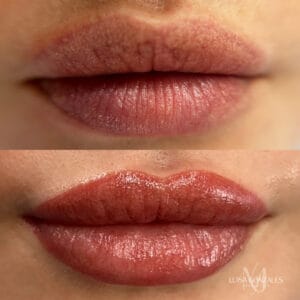
What is lip blush?
Lip blush is a form of semi-permanent makeup (SPMU). Using a fine cosmetic tattoo device, we deposit pigment into the very top layers of the lip to enhance natural colour, even out tone and soften the border so the shape looks more defined.
The result is a sheer, diffused tint rather than a solid block of colour: think your favourite tinted balm, not a bold matte lipstick. Every shade is custom blended to your skin tone, your natural lip colour and the look you want.
- Restores colour to pale, faded or uneven lips
- Softly defines the border and can balance mild asymmetry
- Creates the illusion of fullness through colour and shape, with no filler involved
- Typically lasts one to three years, with a top-up to keep it fresh

Lip blush gives you colour and definition. Lip filler gives you volume. They’re two completely different treatments.
Lip blush vs lip filler
We hear this mix-up every week, so here’s the short version. Many clients enjoy both, but they do very different jobs.
| Lip blush | Lip filler | |
|---|---|---|
| What it does | Adds colour, tone and definition | Adds volume, structure and hydration |
| How | Pigment placed in the top layers of the lip | Injectable gel placed within the lip |
| Changes volume? | No. Fullness is an optical effect of colour | Yes, that is its purpose |
| Lasts | Around 1–3 years, fading gradually | Usually months rather than years |
FOR DARKER & UNEVEN LIPS
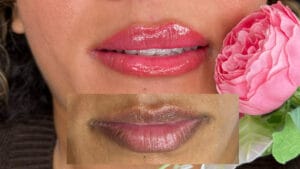
Dark lip neutralisation
Lips can naturally carry more pigment, or darken over time through genetics, sun exposure, smoking or post-inflammatory pigmentation. The result is often a two-tone lip, a darker border, or cool blue, purple or greyish undertones that lipstick never quite covers.
Neutralisation uses colour theory. Warm correcting pigments in orange, peach or salmon tones sit opposite those cool shades on the colour wheel, so they cancel them out. Once the lip is balanced, we can build towards the rosy or nude shade you actually want.

It’s a journey rather than a single appointment. Most clients need two or more sessions, spaced several weeks apart, because we work in gentle layers and let each one heal before assessing the next. Going straight in with pink over dark lips is how you end up with an ashy or grey healed result, so patience here really pays off.

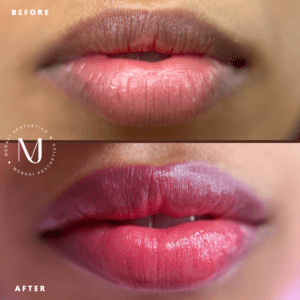
The healing journey
Healing is where most of the surprises happen, so it helps to know what’s normal. Everyone heals a little differently, and we’ll give you full aftercare on the day.
Days 1–3: Bold and a little swollen. Colour looks much brighter than the final result, and lips may feel tender and tight. Completely expected.
Days 3–7: Flaking. Lips start to peel, a bit like after sunburn. Let the flakes come away naturally and keep them moisturised as advised.
Weeks 1–3: The “ghosting” phase. Colour can look like it has almost disappeared. Don’t panic: the new skin is sitting over the pigment.
Weeks 4–6: Colour blooms back. The true, softer healed shade gradually comes through as the skin settles.
Weeks 6–8: Perfecting session. We refine colour and shape at your top-up. For neutralisation, this is where we assess and plan the next layer.
Myths vs facts
Myth: “Lip blush is basically lip filler.”
Fact: Lip blush adds colour and definition only. It doesn’t add volume, although balanced colour and a crisper border can make lips look fuller.
Myth: “It’s permanent, so I’m stuck with it.”
Fact: It’s semi-permanent. Pigment fades gradually over roughly one to three years, depending on your skin, lifestyle and sun exposure, so your look can evolve with you.
Myth: “It’ll look like I’m wearing lipstick all the time.”
Fact: Healed lip blush is sheer and natural. You can wear it bare, or treat it as the perfect base for gloss and lipstick.
Myth: “The colour on day one is what I’ll end up with.”
Fact: Fresh colour is always more intense. It softens considerably as lips heal, which is why we judge the final result after the healing period, not on the day.
Myth: “Lip blush doesn’t work on dark lips.”
Fact: It absolutely can, with the right approach. Dark lip neutralisation corrects cool tones first, then we build colour on a balanced base.
Myth: “It’s unbearably painful.”
Fact: We use topical numbing throughout. Most clients describe a scratchy, vibrating sensation rather than pain, and the lips are the most sensitive the day after, not during.
Myth: “One session and I’m done.”
Fact: Lip blush is a two-step process: the initial treatment plus a perfecting session. Neutralisation often needs a few sessions to get to your final shade.
Who is lip blush for?
Every treatment starts with a consultation, where we look at your natural lip tone, talk through your medical history and agree on a shade together. We’ll always be honest if something isn’t right for you yet.
Great for you if
- Your lips are pale, faded or uneven in tone
- Your lip border has become less defined
- You have darker lips or a two-tone lip
- You want to wake up with “done” lips, minus the daily lipstick
Let’s talk first if
- You’ve ever had cold sores. You may be advised to take antiviral medication beforehand
- You’re pregnant or breastfeeding. We’ll wait until after
- You’ve had lip filler recently. We’ll advise on timing
- You have a special event coming up. Allow time to fully heal
Want to read more?
A few trusted places to learn more about lip blush, neutralisation and safe cosmetic tattooing.
- Lip blush healing timeline: what to expect each day (Biomaser)
- How long does a lip blush tattoo last? (Daela Cosmetic Tattoo)
- Lip neutralisation 101: pigments and techniques (ID Liner Pro)
- Lip neutralisation: what it is, how it works, what can go wrong (La Bouche Parfaite)
- Dark lips: common causes and treatments (Healthline)
- Cold sores: diagnosis and treatment (American Academy of Dermatology)
- Tattoos and cosmetic procedures: patient information (UCLH, NHS)
- Tattooing: infection prevention and control guidance (GOV.UK)
Thinking about lip blush?
Whether you’d love a soft wash of colour or you’re curious about neutralising darker lips, drop us a message to find out if you’re a candidate. We’ll talk you through every step.
Drop us a message on Instagram: @merakiaesthetics.london